Simple But Not Easy
- Short Summary: Though being a good leader is hard work the components are simply common-sense.
Two of my grandchildren are under the age of two. Active little boys, they give me such delight as I watch them develop and grow. They also make me gasp in fear on a regular basis.
Just the other day, I looked up and saw the 21-month-old carefully walking down the stairs from the 2nd floor, holding a fairly large (for him) wooden box in his hands, and therefore not holding on to the railings. We’ve been teaching him stair safety, which involves sitting on his little bottom and scooting safely down the steps. But apparently this box (absconded from his older sister’s bedroom) was just too absorbing. He forgot about scooting entirely.
I managed to keep my cool, walked up the steps, and hovered in front of him while he successfully navigated the stairs one foot at a time. At the end of his trip down the stairs, he was very proud of himself and I was sweating.
But I realized that he was ready for the steps. He has been practicing walking up and down our miniature dachshund’s stairs (yes, she’s 14 years old and needs them to get on the couch) for weeks. Before that, he had mastered running. Before that, walking. And before that, he crawled.
This biological and intellectual advancement follows a very set pattern. We’re watching his 7-month-old brother go through the same developmental steps now. As they get older, they will do some things earlier, some things later than each other, but the pattern of human development is pretty well set.
As it is with business development.
Unfortunately, many people who start and run small businesses don’t understand that there’s a sit-crawl-walk-run-stairs progression to business. They jump in wherever they are most comfortable –usually making or selling something – and just go from there. It’s no wonder so many of them fall down the stairs.
The strategic process was probably not as important to a grocer opening a store in a small town with no competition 70 years ago. But with each passing decade and the associated improvements in technology, the disciplines of strategy, establishing competitive advantage, branding, marketing, and operations have become more and more important. Today it doesn’t matter if you are a very small business or a very large one – these skills are critical to sustainability and profitability.
The good news is, if you follow a logical, tested, practical process, you can implement all the strategic building blocks your company requires. Explaining all of those building blocks in one blog post – or even one book! – would be ambitious. Today, I just want to share with you the crawl-walk-run-stairs order of business.
Each step informs the next step. The sales plan must come after the brand (which came after the overall strategy), and you need the numbers from the sales plan to complete the business plan (which is running roughly parallel to it). Staying with the external track, once you know your sales plan, you can create marketing strategy to achieve the sales goals, and the marketing plan is the month-to-month playbook to achieve the marketing strategy.
The inside track has the same sit-crawl-walk-run-stairs progression to it. Once you complete the business plan, you can make your operating plan, and once you have your operating plan, you can create a cash flow plan and budget.
But what if your business is already in full gear and you realize that some of these pieces are missing? Back up to the first missing element and start filling in the blanks. You will gain new insights, correct business problems, and come up with new ideas along the way.
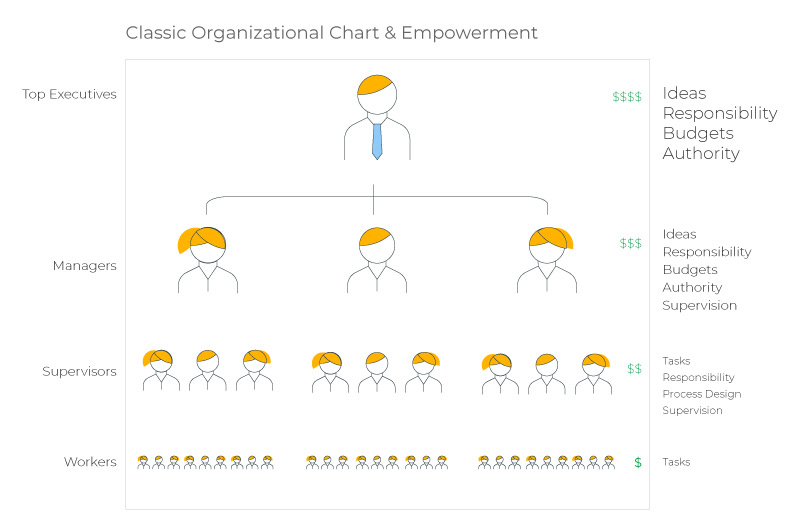
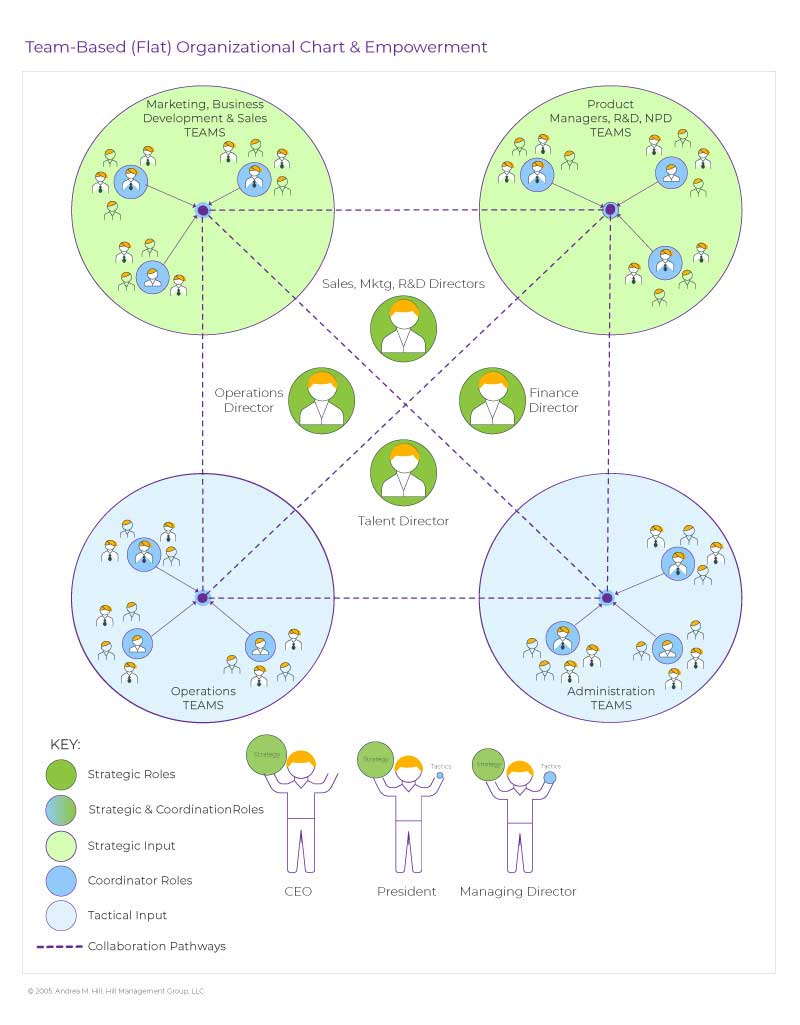
Large corporations have overwhelmingly made the transition to team organizations in the past 15 years. All of them approach teams in somewhat different ways, but the unifying concept is that they understand the need to reduce the number of layers in their hierarchy and increase the autonomy, creativity, and financial contribution of their workforce.
The trend was not ignored by mid-sized companies, but they have been slower to convert. That may be partly because mid-sized companies are frequently private, but it may also be because they have not experienced some of the strains on capital and capacity that larger companies experienced during our last two recessions.
Now more companies want to make this transition, and I am frequently asked how difficult the transition will be. There is an impression that we should be able to go from soup to nuts in a year or less. That is extremely optimistic, and unless a company is unbelievably well primed for such a transition, probably impossible.
The system implications of going from hierarchical to flat are huge. The areas in which I have seen the biggest impact are in communications, motivation & compensation, project management, and of course, technology requirements. The umbrella over all of this is that the culture itself changes.
Let's just talk about project management for a minute. In the old approach to project management, a management person (i.e., someone with role authority) would set up a project, assign resources, expectations and due-dates, and let everyone know what their job was. Employees would more or less successfully complete the tasks more or less on time. The projects were usually done within a functional silo, so if it was a product development effort, for instance, engineering would have one project plan for the invention or development of the object, marketing would have one project plan for the promotion, pricing and feedback on the item, and sales would have yet another project plan for the launch of the item.
That approach to project management is fraught with difficulty, largely because of the throw-it-over-the-wall effect of working in silos. Enter team-based project management.
Now a project manager is selected from any one of the disciplines identified above. They may or may not be of significant management role authority, and even if they are, they only have role authority within their divisional area - say, engineering in this instance. They need to set up a project plan, and the team will consist of people from marketing, sales, accounting, and possibly other groups (hopefully they're including customer input, but that activity is still lagging in most companies).
The project manager lacks role authority, so they have to use collaborative techniques to get the rest of the project team to contribute input regarding resources, tasks and due-dates. The team members need to accept the project manager's leadership. Does the project manager even have any leadership skills? Did they get any training or mentorship?
Assume the project has been defined well. Who has budgetary authority and responsibility? To whom do they go to make sure the project funding is adequate (or planning has been adequate)? Does the project have a project champion? And what is their role authority?
The project members all work in different areas of the organization, but they need to be in constant communication. Do they have the right communication technology for this type of work? Email isn't a great medium for project communication. Does IT have any responsibility to provide them with support? And in what time frame?
Say a team member doesn't maintain their part of the project in a responsible way. To whom does the team go? Their usual manager? The project manager? What if they're told to try to address conflict within the team? Do they have any conflict management training? And was the training any good, using a mediation or conflict management method that is known to work?
These are all different system dynamics that are indicated in the change from hierarchical to flat - and that's just in one part of the company! Such transitions are rewarding, both personally and financially, but their complexity should not be underestimated.
I don’t think companies can afford to continue to operate in the old hierarchical ways. Those structures will be the dinosaur bones in the dirt within this century. Flat, networked organizations are not the thing of the future – they are the organizational design of now. So companies thinking about making a transition are wise to do so. But the process needs to be approached with a deep respect for how much time and investment will be required to achieve the desired results. Companies who are just focused on today and tomorrow’s results won’t be able to muster the discipline and patience necessary to change. But ten to fifteen years from now (if it takes that long), they won’t be able to muster the profits they need to survive.
(c) 2007, Andrea M. Hill
Anyone with internet access and a modicum of interest can access a tremendous amount of excellent business advice very quickly. A lot of it is quite good. But time and again I come back to W. Edwards Deming – he is to my business life what Jelly Roll Morton is to my jazz life. He is also the most sage advisor to turn to in times of economic challenge.
One of his recommend management practices is: End the practice of awarding business on the basis of price tag. Instead, minimize total cost. Move toward a single supplier for any one item, in a long-term relationship of loyalty and trust. While no maxim can be held to be true for all its applicable situations, a lot of businesspeople would benefit from paying better attention to this particular piece of wisdom.
To apply this, one must first examine the concept of total cost. Though cost-based accounting methods can be credited with advancing organizational ability to dissect operating processes and analyze where change might be most beneficial, cost accounting also has a downside. The very process of apportioning costs applies component-based to thinking to system-wide problems. Does this mean that cost allocations are bad and should not be done? Definitely not! (though I have discovered that this topic has a strange knack for bringing out the argumentative extremist in far too many businessmen). The solution is to recognize that component-based thinking creates a certain type of bias, and that bias can be offset by approaching the same problem (or, ideally, set of problems) with system-based thinking. Here's an example of an actual problem that I endeavored for years to solve, but I could never get the relevant players to accept the rationale or change behavior (cue big sigh here). The group in question even hated the term - - supply chain management. OK, here we go: If you ask a 6th grader to make a list of the things they should consider when purchasing a product for resale, they would probably give you a list like this:
With a little additional prompting (i.e., how is it going to get here? Do you have to pay for that? If you don't, does the price show up somewhere else? ) you can get them to add:
Most businesses operate very close to this 6th grade list. They may add a few other considerations, such as:
When Deming says minimize total cost he doesn't mean even this slightly more expanded list. He means to consider a host of other issues that present themselves within the system of the supply chain. That list looks something like this:
This list is more like what Deming was talking about when he said companies must minimize total cost. And though selling price must always be set with a keen eye toward competitive environment and a company's specific value added, product cost considerations should at least involve contemplation of this whole list – not just direct product costs.
As you review the list you can probably think of various supply chain minefields from different companies you have worked at over time or different vendors you have dealt with. Three of the most common areas of inflated total cost relate to quality issues, receiving difficulties, and accounting management. I remember being told by one particularly self-impressed purchasing agent that her time was infinitely more valuable than the time of the people in the receiving department. Well I don't know how she figured it, but a week-worth of her time at, oh, let's say $25/hour ($1,000 total) to problem solve with the vendor to reduce receiving issues, or even another $1,000 week-worth locating a superior vendor and negotiating a contract, would be worth it. Consider the alternatives: three people at $11/hour spending an additional three hours (on top of the two hours already allocated – not in this calculation) to receive the products every shipment (say, 5X year) equals $495. Another accounting person to handle system adjustments, questions of the vendor, and rebalancing accounts (1 person X $16/hour X 2 hours X 5 times per year – or $160). But then, the real kicker. The receiving department and the accounting department each need to hire one additional person, because a handful of accounts like the one I am describing results in their inability to stay on top of their service level agreements. Cost? For wage and benefits loading (at 30%) $29,744 for the receiver and $43,264 for the accountant. For Pete's sake - do the vendor management!
Deming also alluded to the difference between a really great supplier relationship and an average one. Loyalty and trust. Trusting supplier relationships aren't just based on whether or not you pay your bills on time (though that is certainly important). They are also based on whether or not you provide them with timely information, give them information they need to be better performers, make only commitments you can keep, and never promise what you can't deliver in terms of sales volume.
Not to be undervalued at any time, the importance of supplier relationships increases dramatically during times of economic stress and uncertainty. Difficult economic times highlight the difference between excellent companies and those that are merely average. If you want to experience a successful 2008, you'll put your best people or your best effort on managing supplier relationships and operations related to supplies - and you'll take great pains to ensure that those departments work seamlessly together with respect, trust, and cooperation. Managing a business through recession is all about cash flow. Keep in mind the entire system when you try to figure out who is sitting on your cash.
(c) 2008. Andrea M. Hill
In Theory of Constraints, Eli Goldratt teaches that business policies are frequently behind business dysfunction. In fact, he names policy constraints as the primary culprit behind business bottlenecks. Though my last company was not particularly policy heavy, this teaching still held true, as a few times each year we would discover some policy getting in the way of exceptional service or smart decision-making.
Now that my transition from corporate executive to consultant is complete, vigilance against policy constraints is one my the primary activities. It is amazing, and sometimes disheartening, to discover how awry an originally well-intentioned policy can go.
The larger a business grows, the more difficult it is to manage communication among all of its constituents. Managers are the primary instigators of policies. Managers need policies because they can not be all places at all times. They fear two things – they fear subordinates simpling makes a decision (and possibly making the wrong one), and they fear the opposite problem of nobody being willing to do anything until the manager comes back. When I first arrived at my last company, an entire department wore t-shirts that said "We'll all know when (insert name here) is back." That's pretty broken!
But even in more functional environments, well-meaning managers create policies that are intended to guide behavior. In some cases, the policy is intended to hold people accountable, such as policies that require all shift changes be approved by a manager. I don't believe policies keep anyone accountable, because accountability is something an individual chooses regardless of external pressure. You can't make someone accountable. You can point a finger at them, or you can ask them to take responsibility, but accountability is an individually chosen perspective. Southwest Airlines – with their 33,000 employees – allows their employees to switch shifts with a co-worker without managerial approval. Consider how much time managers save by not having to sign off on (or even discuss) all those shift changes! Their ability to ditch the policy is based on hiring accountable people in the first place - proving that the inverse of enforced accountability is more cost and time effective.
Policies may serve the purpose of creating a situation where the rules are clear and therefore the consequences of not following the rules are also clear, but they can also create a situation that is rife with politics, negative creativity, and games. The Civil Rights Act of 1964 introduced remedies against Quid Pro Quo sexual harassment and Hostile Work Environment sexual harassment – both policies that were needed and welcomed by working women (and men) across the country. But those "policies" have been distorted repeatedly, leading to overly-stringent corporate sexual harassment policies that terrify men and effectively neuter the workforce (if you want to read a great book on this topic, read Heterophobia: Sexual Harassment and the Future of Feminism by Daphne Patai – it's excellent). These corporate policy reactions are due to abuses of the policies, overweening HR departments, and faint-hearted corporate law departments. The end result? Dysfunction.
Some policies are unavoidable. Federal labor law policies are an example of that. But just because something is a federal law doesn't make it a desirable policy. Look at all the money and lives wasted on enforcing an absolutely unenforceable drug policy - nobody is accountable, though we tax payers continue to pay the accountants. If policy constraints are costing us at the corporate level, what are they doing to us at the level of national government?
It is desirable for an environment to operate on sound principles rather than rules and policies to the greatest extent possible. I don't think that all policy can be removed - that's utopian. But I do think that much of what we try to govern with rules is situational and the rules have to be shoehorned to fit the situation. Sound principles will serve diverse situations much more effectively than rigid policies, and the system can continuously adapt itself accordingly. In the meantime, all of this policy dysfunction is part of what's keeping me in a job.
(c) 2008. Andrea M. Hill
I was working with a client yesterday and she expressed a fear that is common to many people these days. This woman is extremely intelligent, highly successful, and well disciplined, yet she has the fear of being professionally and technically left behind.
It’s a reasonable fear. The world is changing quickly, driven largely by the pace of technology innovation. Twenty years ago everyone was aware that computers were changing the face of business, but the general perception was that computers were the domain of ‘computer people.’ 15 years ago business sociologists were telling us that the big chasm between Baby Boomers and Generation Y would be a difference in work ethic. Today it is apparent that Boomers are alienated by technology that their Gen Y counterparts take for granted.
Emerging manufacturing technology highlights the insufficiency of tool and die skills without computer aided design skills. Marketers who can’t navigate high end software and challenging database environments fall behind. Warehouse workers interact at a high level with automation tools such as mini-computers strapped to their wrists. Artists and craftspeople must master the demands of having their own websites – or at least be capable of providing direction to a website developer and manager. And the business executive who can’t independently navigate the myriad of internet and wireless protocols can get shut out of their business for days on end (or drive some poor IT support person crazy at all hours).
The challenges go beyond computerized workstations. Defined benefits and company-provided pension plans have given way to individual structuring of retirement strategies – leading to a requirement that all individuals understand markets and economics and investment strategies – which themselves become more complex every year. Competition is constantly changing as the barriers to entry for new business continue to shrink. Even our communication is evolving rapidly as language becomes more technical.
Some people have opted out of the whole problem by declining to develop computer or technical skills. I don’t consider this an option. Anyone reading this blog would agree that the inability to read or write is a guarantee of economic deprivation. I believe computer illiteracy will contribute to a similar result in the near future (and to a certain extent, already is). If you moved to a non-English speaking country, you could not expect to gain successful employment or integrate into society without speaking the language. In the case of computers and technology, the other language has moved here, and everyone must be proficient. When a normally intelligent person “can’t” learn a new skill, resistance – not aptitude – is generally the culprit. Ending residual computer resistance will open the door to new competencies quickly for most people.
But what about my client, the very smart executive who is worried about keeping up? In her case, we discussed what she is afraid of keeping up with or in. She has broad business responsibilities, but they are not all-encompassing. So we made a list of the general areas of knowledge in which she can’t afford to fall behind, and then we identified a few key resources to help her stay on top of her game. After evaluating the field of possibilities, she decided she will need to incorporate two new monthly magazines, one weekly magazine, and 4-6 training classes (online or live) each year to sufficiently supplement her knowledge. In addition, she will enhance her project and decision-making work by including more research, particularly research of a peer-reviewed or academic nature. I could almost see her cortisol levels drop as she realized she could design a strategy for staying ahead of her game.
For anyone who plans to work past the age of 60, making a plan for staying au courant in the important developments of their chosen profession is a wise move. The knowledge that sort of stumbles onto us is a gift from the universe. But the knowledge we planfully acquire is an important gift we give ourselves.
(c) 2007, Andrea M. Hill
I am of a split mind when it comes to comparison between the jewelry industry and the fashion industry. On the one hand, jewelry is definitely part of a woman’s wardrobe and it plays an important role in her expression of her fashion sense (this is true for men too, but to a lesser extent). On the other hand, jewelry is more enduring than fashion, lasting far longer than for one or a few seasons.
Of course, there is the whole category of fashion jewelry, which is more trend oriented and typically at lower price points than fine jewelry. Fashion jewelry should be getting a lot of our attention, as social and economic trends show that consumers (outside the 1%) are spending less money less often on luxury goods. In fact, fashion jewelry is where department stores, internet sellers, and boutiques are stealing the independent retail jeweler’s lunch.
These observations cause me to ask two questions:
I suspect the answer to the first question lies in two issues: First, the jewelry industry tends to be very inwardly focused, which has resulted in it becoming further and further detached from the consumer. Second, the independent retail jewelers are still sitting on far too much inventory - and much of the reason for that could be due to the first issue. So let's talk about the fact that the industry is not sufficiently consumer-focused.
To be fair, there is one organization in the industry that is focused on taking-it-to-the consumer: JA’s Jewelry Information Center (JIC). In my observation, that group, led by Amanda Gizzi, does way more with paltry resources than one would think possible, and does more to keep the industry’s interests on the radar of consumer editors than any other organization or even combination of organizations. Without JIC, the consumer press would form its perspectives of jewelry entirely outside the influence of the jewelry industry. Think about that for a moment. Think about how much sway the fashion industry itself has on fashion publications. Consumers form their opinions of fashion based on what the fashion industry tells them to think, through fashion shows, fashion editorial, and what shows up in retail store windows.
But with all due respect to what JIC can accomplish with its limited resources, it’s not enough. Why? One concern is that the industry sends out information to the consumer world in the form of editorial, but it doesn’t receive any feedback, or certainly not feedback that is consolidated enough to consider the implications. Another concern is that consumer-focused promotion is not addressed adequately (in fact, barely at all) at the manufacturer and industry levels.
Fashion shows not only provide information to the marketplace, they deliver almost immediate feedback from the marketplace. Not only do the buyers for all the major department stores show up, but so does the press and a large contingent of influential consumers. At, during, and after each fashion show, there is immediate feedback. The fashions are dissected in the fashion press, the fashion press and business press publish both business and consumer reactions to the styles, and the buying behavior of the department store buyers (well-informed by constant and aggressive consumer research) is a direct line of feedback regarding what will be hot-or-not for that season.
This is also how the Consumer Electronics Shows work for the gadgets industry, how Cannes and Sundance work for the film industry, and how the Tokyo Motor Show and the North American International Auto Show work for the automobile industry.
Of course, these industries are significantly larger in dollars than the jewelry industry.*
But jewelry requires more early and ongoing feedback from consumers than other relatively sized industries such as cosmetics or footwear, where lower price points make experimentation at retail more palatable and in which sports stars, movie stars, and the fashion industry have significant influence. Consolidation of retail in footwear and cosmetics means that individual retail companies have larger advertising and promotion budgets, and it’s noteworthy that the manufacturers of those products speak directly to the consumer in major, ongoing promotional campaigns.
Perhaps a better comparison of a similar-sized industry would be the leisure products industry, which sells high-priced goods like RVs, camping equipment, boats, and 4-wheelers. Through publications aimed at enthusiasts and regional sporting goods shows, the leisure products industry introduces consumers to new features and styles. This gets consumers excited about heading out to retail to buy new toys. Large retailers like Cabelas may have significant advertising budgets, but smaller retailers also benefit from the shows and the promotional support of manufacturers.
What got me thinking about this? An article in today’s Luxury Daily that talks about how the Council of Fashion Designers of America (CFDA) is looking for ways to improve New York’s Fashion Week. According to Steven Kolb, president and CEO of CFDA, “Fashion Week has evolved over the years with the influence of technology, but the format and function of fashion week have stayed the same.” CFDA has commissioned a study to discover how they can “use technology to its fullest advantage, and how designers can best maximize their resources to engage the customer.”
I think the jewelry industry should take this advice to heart as well. A tremendous amount of energy has gone into demanding that DeBeers support the industry (again) with a(nother) consumer advertising campaign, and DeBeers has responded with a half-hearted re-do of its former A Diamond is Forever message. Not only do I suspect this message’s time has come and gone, I also believe that our expectation that DeBeers bail out the industry is misplaced.
The jewelry industry has become a closed system. The majority of its energy is focused on generating income within the industry, with little attention paid to the consumers we require to keep us in business. What is the answer? I’m not exactly sure, though I have some ideas. But here’s what I do know: As an industry, we must talk about this problem. It’s bigger than sustainability, it’s bigger than sourcing, it’s bigger than low-cost manufacturing from other countries, or Blue Nile or Sam’s Club or Costco. In fact, if the industry doesn’t resolve this major disconnect between the consumer and those of us who make and sell jewelry, we could solve all those other problems and still become entirely irrelevant in the next 10 years.
Let’s discuss.
* (US Film Industry: $679 billion; US Automotive Industry: $524 billion; US Fashion Industry: $225 billion; US Consumer Electronics Industry: $208 billion; US Jewelry Industry: $63.3 billion)
We live in a world that tries to ignore the relationships of cause and effect. Ignore, because while we know that eating the wrong diet can damage our hearts, many do it anyway. Ignore, because while it’s only common sense that buying a house you can’t afford will lead to financial distress, many did it anyway. Ignore, because though it seems fairly obvious that failing to invest in education will ultimately damage our country, so many are willing to do it anyway.
We ignore connections, even when they are obvious.
But sometimes we don’t understand the connections in the first place. For instance, until recently the average medical doctor only received the equivalent of two hours of instruction in nutrition during his entire medical training, even though our bodies are chemical factories that are completely at the mercy of the chemicals (food) we put in them. Without deep knowledge of the basic chemistry and mechanics of food production and nutrition, most doctors do not understand the connections to health and prevention. Does this make them stupid? Of course not. Uninformed, leading to reduced ability to problem-solve, yes. But stupid? No.
This failure to make connections is not isolated to the medical community. Business owners regularly fail to make the connections necessary to ensure the health of their businesses. The problem is that most business education does a pretty decent job of teaching each of the elements – disciplines – of business, but does not do such a good job of teaching the connections.
Inputs and Outputs
But it’s quite simple really. And once you start thinking about business in the way I’m about to describe, you won’t be able to stop. How easy? Well, consider this.
We all know that the desired output of a lamp is light. If I asked you which element provided the actual light, you would say it was the light bulb. And then you could elaborate and say that the electronics inside the lamp provide energy to the light bulb, that the power cord is what delivers energy to the electronics, and that the power cord must be plugged into the power grid of the house through a power outlet.
The only output in that analogy is the light from the light bulb. Every other element is an input. Business is the same.
Outputs are the things your customers experience as a direct result of their awareness of, or relationship with, your company: The products and services you offer, the environments within which the products and services are delivered, the messages the company conveys, the discussions consumers have about the company either face-to-face or through social media, and the reactions they get – both good and bad – to the products and services they have purchased from you.
Inputs are all the things you do to deliver those products, services, messages, and post-sales support and to influence or respond to consumer-driven communication about your products and services.
Have you ever wondered which elements of your business you should prioritize for investment and development? I just gave you the answer. Well OK, maybe there’s a little more to it than that.
Imagine that you own a business that designs shoes. No, that’s too broad. Imagine that you have a business that designs orthotic shoes. Your desired output is a shoe that a podiatrist can recommend, and that a consumer is willing to wear, both because it performs as expected and because it looks like an attractive shoe and not a medical device. Your target consumer is a woman who works full time on her feet in an indoor, non-industrial profession – like a nurse, medical technician, or retail sales professional. Everything else you do must enhance and protect these outputs.
So what are your inputs? To figure that out, work backward from the ‘light bulbs’.
In this diagram, the outputs are the products, marketing, sales, service, and public discussion as perceived by the customer. Everything below the red line is an input. Each input necessary to achieve a desired output represents an important investment. You make your decisions from the top down.
Failure to invest in your critical inputs will guarantee failure of your outputs.
So here’s where we return to the concept of cause and effect. Because if your business strategy is built on weak inputs, it’s just a house of cards, and the lowest layers must be built and strengthened before the upper layers can produce economic value.
Simple, right? Now if I could just get that stupid song out of my head.
The shin bone’s connected to the . . . knee bone. The knee bone’s connected to the . . .
© 2010. Andrea M. Hill
I think the business world should banish the phrases “I have a great idea!” and “here’s a great idea!” and “what we need now is a really good idea.” I don’t think these phrases are doing anyone any good. In fact, they’re damaging.
That might seem crazy to you, dear reader, because business-people are supposed to be coming up with new ideas, right? All the time, right? What is the latest, biggest business buzzword? Innovation. And it’s used so often and with so little meaning that, well, it’s meaningless (meaning and meaningless are good words, but that’s not what we’re talking about today).
So, why do I have a growing opposition to the idea of the word idea? Because it’s a word for dilettantes. Anyone can have an idea, and from what I can tell, everyone does. My five-year-old granddaughter has about 275 ideas each day. My young adult children have a lot of ideas too, though I assume I’m not hearing about most of them. Just last week I was spending time with my nephews Caleb and Owen, who are 4 and 1. Boy, do they have a lot of ideas, most of them funny. So is it the fact that just anyone can have ideas that turns me against the idea of ideas?
Sort of. Let’s take it a step further. Remember those summer days when you were a kid and you sat on your back steps with your buddies from the neighborhood? Everybody sat there and threw out ideas for what to do that day, and this activity would go on for a while until an idea emerged that everyone could agree on. What was the difference between that final idea – the one that sent everyone on their way – and the first dozen or so? Intention.
Kids are good at putting intention to fun. They have all of their ideas with the ultimate goal of fun in mind. But businesses don’t seem to benefit from a common group intention, so too many of the ideas don’t lead to a common group activity. When kids negotiate about what activity they are going to engage in, they are all committed to the idea of having fun, and there’s little reason to compete with one another in the process, so they don’t. When adults negotiate about which idea they are going to commit to, they have all kinds of barriers, personal agendas, and competitions to navigate. When negotiation around ideas is too painful or fraught with risk, people won’t engage in it. What’s the next best thing? Apparently, just having the ideas in the first place!
I know (and you probably do too) executives who use up perfectly good oxygen in meeting rooms all over the country while practicing the art of self-stimulation for hours on end – dandling their ideas on their knees, trotting out their ideas for others to admire, and basking in the after-glow of being recognized as the idea person. Then, they return to their offices to continue the status quo until the next highly stimulating opportunity to indulge in a bit of idea stroking presents itself again.
What the business world needs – well wait, why limit it to that? What our personal lives, our families, our communities, and the world need, is more intention. Sure, let’s cough up some new ideas now and then, but really, how many more do we need?
What about all the great ideas that have already been born, that could solve problems if they were just implemented? Believe it or not, most of the problems business faces – and indeed, the world faces – have already been addressed with at least adequate and in most cases really good ideas. Even if the ideas are merely adequate, putting intention to them would be much better than doing nothing while waiting for a better idea to manifest. And the better ideas are likely to come about as a by-product of implementing the merely adequate ideas anyway, so why don’t we just get going?
Try saying this out loud: “I have the best intention.” “I just had a new intention.” “Wow, I heard the best intention today.” “What we really need is a few good intentions.” (Seriously. Out loud. Nobody’s listening, and if you’re so worried about it, close your door).
Can’t you feel the difference? Your personal quest, your family, your management team, and hey – possibly the world – are waiting to feel it too.
(c) 2007, Andrea M. Hill
1. Culture. Know your business proposition and culture. If you have established your business as a technology and product leader, you need to build a management team capable of healthy competition. If you have established your business as a customer relationship company, then you need a management team that can collaborate. If you are a low price leader, then you need to build a management team that can carefully control the organization. If you don't get this first element right, none of the other elements will pay off to their full potential.
4. Communication Ground Rules. Set them. Debate is healthy and important, but make agreements with the group regarding what the ground rules will be to ensure everyone is treated with dignity and respect. Make it clear that crossing the line will result in a time out. A very important ground rule for the leader is to make sure that when someone crosses the line and gets called on it that IS the repercussion. Why? Because at first - particularly if your management team has a habit of dirty arguments - they won't know how to follow the new ground rules. If they can stay loose (i.e., not afraid or cynical), they will pick up the new behaviors quickly. But if the new situation is threatening, you'll just replace dirty arguments with repression. You may need to have a conversation with one or two folks if they repeatedly have time-outs called on them, but you will be surprised at how quickly the nature of debate in your management team changes. Some people will begin to participate that opted out before, and others will make it a little safer than they once did.
(c) Andrea M. Hill, 2007
Sometimes I listen to parents complain bitterly about things their toddlers – or teenagers – are doing; things which are totally age-appropriate. If you’re like me, you think to yourself, “as long as you're a parent, you would have a better time if you learned about the developmental stages of children.”
I had a friend who once decided to ride his bike from Albuquerque to Santa Fe – a 65-mile trip. Half way through his journey – and in the middle of nowhere – his bike broke down and he didn’t know how to fix it. If you’re just riding your bike around the neighborhood, you can get away with not knowing any repair skills. But if you’re going to start making long treks in sparsely populated areas, you need to learn how to fix your bike and own the proper tools.
There are probably many things you wouldn’t do without learning a lot about them and practicing first: true wilderness camping without survival skills, throwing a huge self-cooked dinner party without cooking skills, sailing a boat in the ocean without navigational and boating skills.
Are you running a small business without small business success skills? If you are, it’s going to cost you.
As a small business – or even a micro-business – owner, you must do all the things the CEO of any company does; decide what to sell and how to sell it, whether and when to hire help, manage customer service, operations, and finances, make decisions. Even if you don’t have formal investors, you are managing a huge investment – your own. Your investment is the time you spend, the money you put in, and the profits you roll back in. You are responsible for all the same things as any CEO, but without the qualified support staff to fill in the gaps in your knowledge.
I was the CEO/President of several corporations over the past 30 years, from a $2million/year marketing agency to a $100million+ jewelry company and a $600million+ apparel company, and now I own a multi-brand consulting agency. The skills I needed between the $2 million level and the $600+million level were remarkably similar. I didn’t need to “be” an accountant, but I had to know how to discuss finances intelligently with my accountants. I didn’t need to “be” a production manager, but I needed to understand what my production managers were doing and how to help them be more successful. I didn’t need to “be” the computer network manager, but I needed to be competent enough to weigh the suggestions my network managers made and make good decisions.
When I first took over the apparel company, I realized that my accounting skills were lacking to do the analysis at that level. Did I go back to school to become an accountant? Absolutely not. But I did go take a class called “Financial Management for Non-Financial Managers” offered at a local community college. That, plus a lot of attention and practice, turned me into a strong financial manager capable of not driving my accounting staff crazy, and more importantly, of being the CEO my company deserved. Every year of my career I have added more business skills to my portfolio, and I continue to do so today. You must do this too.
You probably already know how to make and/or acquire the products and services you sell. This is the starting point for most entrepreneurs. But there are several business skills you must cultivate in order to ensure the survival and profitability of your company. These small business success skills include:
Being a business owner is a big task, and I’m not going to pretend that list is a quick or easy thing to master. But if you start learning these skills right away and keep picking them off one-by-one, you’ll become a better CEO from the moment you start . . . and the time is going to go by either way.
This is a link to a chart of these skills. It is structured as a pledge; a pledge to yourself to pursue and cultivate the skills you need to succeed. I encourage you to print it out, post it in a highly (and daily) visible spot, and check each one off as you tackle it. And here’s to you, on the road to becoming a highly competent – and vastly more satisfied – CEO.
One of the most constant things we must do to run a successful business is lead, and that's really hard work. Leadership requires a lot of consistency and discipline. In a very big business you can distribute that leadership among many managers, and as long as most of those managers are effective in that role the overall business does OK. But in a very small business, any deficiencies in leadership can quickly lead to morale problems and other types of dysfunction in the workforce. This is the small business leadership challenge.
It's one of the biggest challenges facing small business owners, because they are not only faced with the constant demands and worries of the business itself, they must also take leadership roles for which they don't always feel equipped or perhaps even interested. Dealing with the people aspect of running a business is often more exhausting and demanding for small business owners than cash flow, financing, or sales struggles.
The good news is that these skills can be honed over time, but it's not always the way you want to spend your energy, so it's a challenge. And it's a challenge unlike developing new computer skills or financial knowledge. It requires looking hard at yourself and evaluating how effective you are inter-personally, what you can do to be a better communicator, and how you can express your irritations and frustrations in positive ways even when that's not what you feel like doing.
If you have more than three employees, take a look at your current business experience and analyze what percentage of your frustrations are people related versus business/task related. It may be that you are experiencing the small business leadership challenge right now.
Who hasn’t experienced that moment of dread when we first realize a serious mistake has been made? The initial feeling is great insecurity: How did this happen? What will my boss think of me? How will my peers view me? Will this cause us to lose clients? Market share? Brand value? Could I get demoted? Lose my job?
What happens next is driven by personality, character, and (hopefully) company culture. Do you immediately raise the alarm, own it, and figure out how to address it? Or do you take the opposite approach and bury or try to obfuscate? If the mistake is being reported to you, do you get angry and place blame? Pile on criticism even as someone tries to be accountable? Or do you go into problem-solving mode with them?
It’s in the what-happens-next that great businesses (and leaders) distinguish themselves from the average and the insufficient. Mistakes provide the ultimate training ground for one of life’s greatest teachers … process.
I used to think that having an eidetic memory would be an incredible advantage — that the ability to remember everything I ever read, learned, or experienced would help me to excel. Then I encountered someone who had an eidetic memory, and she helped me change my mind.
First, she pointed out that the downside of remembering everything one ever experienced is at least as great as the upside. Fair. Second, she distinguished between knowing something and being good at something. And she was right. Before I mastered bread-baking I memorized the ingredients and instructions, but I had to experience the process multiple times before I could make a loaf worth eating. Before I had the opportunity to lead large numbers of people I studied leadership, motivation, and management. But I had to apply all that knowledge to real life and make real mistakes to develop leadership skill.
The person with the eidetic memory was clear about the limitations of her gift. She was able to recall volumes of content with remarkable precision, but the knowledge ended there, because she lacked the experience to apply and connect much of it. In her words, she was “like a librarian, only faster, because I don’t need to consult the card catalog.”
It is through this lens that we can best understand that the purpose of business is not end results, but process.
I can feel the feathers ruffling from here as everyone who has ever created a quarterly shareholder report, attended a management meeting or been the evalu-ee in an annual employee review shakes their heads, clenches their fists, and gasps aloud at how any serious business practitioner could fail to grasp the all-consuming requirement of RESULTS.
I would like you to pat down those feathers, take a cool sip of water and consider how fixation on results over process ultimately leads to lack of innovation, the failure of employees to thrive, loss of competitiveness and even erosion of ethics.
Perhaps 90% of what happens in a business is repetitive process. From accounting to customer support to product development to marketing, each functional area of any business involves countless processes done by a sometimes stable, sometimes changing group of people. Admonishments to deliver “great customer service” will rarely yield the results you desire, but focus on improving the processes by which you deliver customer service can lead to greatness.
One of my great frustrations as a business owner is how I often end up doing things myself because it’s faster than handing off the task. But peek behind the curtain of that frustration, and the problem is me. Many of the tasks I do are largely intuitive, based on decades of experience and muscle memory. But this doesn’t make the way I am doing them the most efficient nor even the most effective.
When you stop and think through a process sufficiently to write it down so someone else can do it, you invariably improve the process. You will find gaps in the process that could lead to error. You will uncover assumptions that are no longer (or perhaps never were) relevant. You can visualize where you are taking three steps when one would be sufficient. When process documentation is done as a group, you discover how many different ways people are doing a process. As the group streamlines the process and learns from each other, the resulting process conformity decreases errors. The act of documenting a process leads to greater efficiency and quality.
When the organization achieves process uniformity, the first and obvious benefits are that errors go down, quality goes up, and efficiency improves. Those would be reason enough to embrace the value of processes. But there is still more benefit to be had.
The way you maintain process uniformity is to insist that process change is always an option, but that process change itselfis a process. In every organization there are always a few people that perform head-and-shoulders above the others. Some of this will be due to innate talent and drive. But some of it will be that those people are improving the way they do their processes - improvements the rest of the company does not know about.
If your process change practice requires that anyone who has an idea for improving a process must bring that improvement to the group for discussion, testing, and agreement, then two things will happen: 1) genuine improvements will make it to the rest of the organization, and 2) ideas that are not actually improvements will not make it into the live environment.
When working with companies to set metrics for profit growth and quality improvement, one of the performance drivers is always related to process improvement. How does this look? Here are a few examples:
Goal Example 1: Increase Overall Customer Satisfaction Score (CSAT)
Goal Example 2: Improve Return on Product Development Investment
If you start with the assumption that any process can be improved, and you proactively review the processes underlying every business goal, your ability to deliver the desired results will improve. After all, result metrics are simply the what. Process improvement is the how.
But what about all the things that happen in a business that aren’t repetitive processes … the mistakes and the anomalies?
As I mentioned earlier, once the mistake has been discovered, what happens next could easily come down to differences in character and responsibility. But your business can’t afford that. You need problems to be effectively addressed as quickly as they are discovered.
The first step is to have a process for addressing mistakes.
Simply having a process for solving problems is an important nod to the reality that mistakes will happen. Companies that acknowledge that mistakes will happen and create methods for addressing them eliminate some of the defensive behavior that can make problems worse. More importantly, you can create a culture that responds with creativity rather than punitorily to mistakes, and this is where the magic happens.
Most mistakes are honest mistakes. In an environment where process is respected and processes are well-documented and trained, mistakes are generally the result of changing conditions in the market, new technologies, new business expectations, or evolution of the business model. It is impossible to anticipate all the ways that internal and external change might lead to mistakes (though it’s important to try). For those things we don’t anticipate, mistakes become our professor.
When a team engages in the problem-solving process, they go from knowing something to understanding something. Without the problem-solving process, they may only know the most superficial aspect of the problem, such as “Mark screwed up,” or they may even know that “Mark didn’t realize that Erin recorded the changes in inventory values incorrectly, and as a result we owe a lot of back taxes.”
Moving beyond knowing to understanding requires figuring out why Mark didn’t realize that Erin recorded the changes in inventory values incorrectly. A well-defined problem-solving process will help you define the problem, determine the cause of the problem, explore any other variables that could also lead to the problem, and create a solution that not only addresses the current problem but also prevents it from happening in the future. This will make your company more efficient and resilient.
It can also lead to consistent, even transformative, innovation.
This aspect of process management is incredibly exciting. Ask a group of people in a room to come up with a new idea, and watch the human embodiment of writer’s block unfold before your eyes. After uncomfortable silence, the ideas will either be based on things other companies are doing already or so far out there that you need a rocket to reach them.
Outside of silver bullets (which are widely published but rarely occur), most transformative innovation comes as a result of evaluating how something is done so observantly and so often that you are able to identify new opportunities that you couldn’t see or which were not possible before.
Commitment to continuously improving the processes of the business IS a commitment to results, but it brings with it the possibility of evolution and innovation. More importantly, you begin to see the truth of business results: Namely, that a result is simply a lagging indicator, but process is what drives the entire organization forward.
In psychology, when a person avoids responsibility for his or her life and problems by investing heavily in the problems of another person, it is called codependence.
We may be in the grip of a virulent form of mass business codependence.
The current economy provides an excellent mask for bad business decisions and a protective balm for bruised egos when a business falters. After all, “everyone’s suffering.” But just as the codependent individual must ultimately break the control of the dysfunctional person dominating his or her life, so must business owners turn away from the excuses offered by a recessionary economy and take control of their business. If they do not, they cannot hope to have a business worth running when the economy improves.
The problem with things that are bad for us is that they don’t feel bad all the time, and when they feel good, they feel really good. If a business owner finds she can’t get inventory from primary suppliers because she is behind on her trade payments, there’s a good chance the problem isn’t just attributable to the bad economy, though sales decline and lack of cash flow may be the straw that broke the camel’s back. But it feels good to blame the economy, because dealing with the roots of the problem may be overwhelming to both existing resources and her ego.
Blaming the economy might shield her from facing uncomfortable truths about her vendor management or protect her from accepting responsibility for undisciplined financial behavior. But it won’t solve her problem.
A sales manager who is suddenly falling short of department goals might be excused for blaming the economy. But if he has failed to train his department for success during difficult times; if he has not communicated customer mood, concerns, and desires to the marketing department so they could adjust marketing and advertising strategy; if he has been relying on his own sales ability to achieve department goals at the expense of building a robust team, his problems are not attributable to the economy – they are just exacerbated by it.
A company that sat back and depended on existing customers to produce sales during good times – saving money on marketing in the process – can’t lay all blame on the economy when sales and average order values drop precipitously.
A company that maintained money-losing business activities due to unwarranted optimism or ego shouldn’t blame the economy when excess cash to waste evaporates and profitable parts of the business are deprived of essential resources.
A depressed economy takes existing conditions and magnifies them. It’s like stop-action photography. Bad business decisions that would normally unfold over years, instead unravel in a year, a quarter, or even a month. This is how we explain some organizations in every industry thriving while their competitors contract and fail.
Recessions, like extreme weather events, natural disasters, and national emergencies, create pockets in time when nobody gets much done. We stand gaping at the scene and we remain there as long as possible, for comfort and camaraderie as much as for information. But unlike those types of national shared experience, the consequences of the event taking place directly affect us all and will roll out over a much longer period.
We cannot afford to be immobilized any longer. We cannot be codependents of the recession, hiding from our business shortcomings and responsibilities by pointing to the big bad economy.
Nor can we afford knee-jerk reactions. The boiler plate response to a reduction in demand involves layoffs, reductions in hours, slashing of marketing budgets (along with a Hail Mary bet that social media and internet marketing will replace more expensive channels), sale pricing, and putting the kibosh on capital investments and travel spending. If a business is in dire enough straits these measures may be necessary to survive, but they are the equivalent of putting a patient into an induced coma – a coma that is just as likely to kill as the disease itself.
Let us turn our attention to running our businesses with precision, eliminating time and money wasters that were camouflaged during better days, reconsidering ill-advised management behaviors and policies that sub-optimize growth, and ensuring that our organizations – from strategy through operations – are a clockworks of coordinated purpose and activity.
A codependent's issues will not go away if their dysfunctional mate becomes well, and the cure for the economy is not the cure for your business. Use this time wisely to restructure, redirect, repair, and refocus, and you can avoid the lasting damage that will be visited upon businesses that are now gutting themselves with reactionary hara-kiri. You may even emerge from difficulty before the economy at large manages to do the same.
© 2009. Andrea M. Hill
In this six-minute video, Andrea Hill talks about the importance of using your marketing strategy to build a long game of exponential value.
I’m thinking a lot the past few days about how hard it is to play the long game in business. It requires several things most people lack: trust in the future, confidence about their choices, and patience. The requirement for a long-game is true in many areas of your business, but nowhere is it more stark than in the area of creating a meaningful online marketing presence.
When social media first hit the scene in 2007-2008, we were all struck by the instant-ness of it all. I think of an idea, I write it, I publish it. I come up with an idea for a visual, I turn it into a graphic, I post it. Fast, fast fast, right? The problem, is that the ability to produce and post things quickly has nothing to do with creating customer awareness or becoming a fixture of their consciousness. That is slow work, tedious work, and it takes a long time to see results. Because in today’s marketing environment, success isn’t measured by how many messages you can blast out to the public, but by how many meaningful links you can create that will bring a searching public back to you. Let me say that again, because what I just described to you is the most basic understanding of Search Engine Optimization, or SEO. Success isn’t measured by how many messages you can blast out to the public, but by how many meaningful links you can create that will bring a searching public back to you. When we talk about telling stories online, when we talk about creating rich content, what we’re talking about is all the words and phrases you bake into your website that will help a searching person find a product or a service you offer. And that takes time.
Time isn’t the only thing – it also requires a strong CMS website. It requires the creation of lots of good content across articles and products and promotions on your website, and it requires patience as you build out that content over time, and that content gets turned into links by search engines. But time . . . time is the thing that most small business owners underestimate. After all, in the past, you could run a radio ad, and a few people would come in off the street as a result of it. You could run a TV ad or a newspaper ad, and you could see pretty quickly if there was a response. You can run those same ads today, and you might even have a few people respond. The problem is that today’s consumers are completely distracted by whatever is happening on their smart phone, they are inundated with marketing messages everywhere they look and listen, and they aren’t “shopping around” for products like they did in the past. They do their shopping online, and then – if they like what they see – they come into the store to buy (and yes, 90% of all purchases are still happening in a store).
In a recent report on retail, the NRF, or National Retail Federation, reminded its membership that it’s not about “online versus retail.” It’s about “retail dependance on online.” Today’s consumers see online marketing as a seamless part of their retail experience, as they search online for products, knowledge, and references, and then seek products out in stores and in-person. And, how do those consumers FIND your business so you can be the store they walk into? Using search. They search for what they seek, they drill into the links that show the most promise, they check out the ratings and reviews of the seller and the products, and then they decide where to go to buy. The creation of that website content, leading to meaningful links, takes time. The creation of a strong system of references and reviews – which we call Social Proof – takes time. And patience. And more time.
But here’s the interesting thing. In the first two or three months, it feels like you are doing a lot of work for absolutely no results. Then, in the four to six month range, you start to see tiny benefits, but it’s hard to trust them. Then, if you’ve been super disciplined and continued to develop content despite the fear and frustration, at around one year you really start to see results. They begin to build slowly and steadily.
When I first started my blog in 2006, I had a grand total of three readers, and I was related to all three of them. Now, 13 years later, my blog drives thousands of visitors per day to my websites. All those blog posts over all those years serve as links to my online presence. I don’t pay for any advertising beyond my blog, because the rich content I have put on the internet is all the marketing I need. Of course, 13 years is a long time. You won’t have to wait that long to see results – and if you are selling jewelry or other luxury goods, you will need other marketing tools besides a blog. I just use that as an example of the exponential power of rich content.
What you need to remember is that a year or two is not very much time at all. You also need to remember that this IS the way marketing and selling work now. So if you haven’t already, you need to commit to a long game of content creation, so that a year from now, you have already made significant progress. After all – the time is going to go by either way. What do you want to have to show for your business’s marketing presence when next year rolls around?
(c) 2007, Andrea M. Hill
If you go online and search for information on business ethics, you’ll find a few interesting things. The first thing you’ll notice is that the people doing the most thinking about ethics in business happen to live and work in academia. There is a lot of theory about business ethics.
Of course, theoretically, if every business person behaved in an ethical manner, we would have little need for any sort of regulation or legislation around business activities. I know. That sentence cracks me up too. In reality, we take the most egregious offenses and legislate them. Discrimination requires legislation, because there will always be some numskull who thinks it’s OK to only hire people just like him. Stealing requires legislation because . . . well, I can’t come up with a reason, but somehow it does.
I don’t think we need a lot of theory around business ethics – though ethics theory has kept philosophers busy for thousands of years. Fun to study, harder to disseminate. No, I think business ethics can be made pretty, well, basic.
When my now-adult children brought home their Character Counts homework from elementary school, I was a bit mystified. I agree wholeheartedly that children must be taught trustworthiness, respect, responsibility, fairness, caring, and citizenship from their earliest days. But I didn’t understand why they were using precious school time for a big Character Counts roll-out. Then I hung out with some of the other parents, and I began to understand why. But I digress. The fact is that basic character concepts such as these, when thoughtfully applied all day every day, are a powerful business ethics application.
The tough part is achieving the thoughtfully applied all day every day aspect. This is work for real grown-ups.
Let’s take a look at what Character Counts says about Trustworthiness.
Be honest. Don’t deceive, cheat, or steal. Be reliable – do what you say you’ll do.
Have the courage to do the right thing. Build a good reputation.
Be loyal – stand by your family, friends, and country.
Plain and simple, right? Maybe not so much. The toughest one is the one right in the middle: have the courage to do the right thing. That one is tough, because when we do the right thing, people might (probably will) get upset with us. Because doing the right thing often comes with some personal or professional sacrifice. Because doing the right thing will often set you apart as naïve or rigid in the eyes of your peers. That’s why courage is part of that sentence.
Now let’s take a look at what Character Counts says about Fairness.
Play by the rules. Take turns and share. Be open-minded; listen to others.
Don’t take advantage of others. Don’t blame others carelessly.
Treat all people fairly.
Don’t take advantage of others. If you stop and think about it, really think about it, it’s shocking how often we take advantage of others. If you stopped shopping at The Gap, H&M, or Abercrombie & Fitch when you found out they used child labor, then you have a grip on this concept. As an 8-year-old, you likely interpreted this concept to mean not tricking your 4-year-old sibling into doing something naughty. As adults, the executives at The Gap seriously failed to abstract the concept.
The Character Counts section on Responsibility says to think before you act – consider the consequences. In 3rd grade that means not going to the park instead of doing your homework. As a corporation, that means considering the consequences for all your stakeholders (consumers, employees, stock holders, vendors – in other words, people) well into the future.
Well into the future. That’s one of three things that sets the elementary school version of Character Counts apart from the adult version of Business Ethics. Children are capable of being responsible for a much shorter future than adults. Their responsibility typically extends to days or weeks, not months or years. When adults make decisions, we need to be responsible for months and years, decades. Business leaders, particularly those in corporations that have significant global reach or access to capital, need to think in terms of generations.
The second thing that sets the elementary version of character training apart from the business version is distance. Ask a child what you can do to help a person in need (part of Caring), and their answer will likely point to someone very close to home. As adults and business leaders, we must be able to abstract this concept to people very different from us and often very far from us. As a society, we’re not even very good at this close to home. To be ethical in business we must be able to consider people far from us, and extend things like respect, responsibility, caring, and trustworthiness to them.
The third thing that sets the elementary version apart from the adult version is to consider these principles in conjunction with one another. Imagine Vikram Pandit (CitiBank CEO) thinking through the purchase of a $50 million private jet after taking $45 billion in taxpayer funds.
Lesser Self: “I hate the jet I have to fly around in right now. It’s not as comfortable as I would like.”
Better Self: “It’s probably not as bad as flying around in coach on a commercial airline, like most business people have to do.” (be compassionate)
Lesser Self: “But I work so hard for my $11 million dollars per year!”
Better Self: “I dunno. Is that actually logical? Do I really work 261.9 times harder than the average person? I mean, I don’t actually work over 10,000 hours per week. I work a lot, but so do people who have to work two or three jobs. I have to think hard, I guess, but so do small business owners with their lives mortgaged to the hilt, many of whom are my borrowers.” (be accountable for your words, actions, and attitudes)
Lesser Self: “Well, maybe I don’t work more or harder than everyone else, but my work matters 261.9 times more than everyone else’s!”
Better Self: “Now I’m just being an ass.” (resisting the urge to suck one’s own exhaust* *Not found at the Character Counts website)
Better Self: “My company just accepted a major payout from the American taxpayer because we’re in financial trouble. Maybe the right thing to do at this moment is suck it up and fly around on my older model, less comfortable private jet. I can buy a new one later.” (Set a good example for others. Use self-control. Think before you act. Etc. etc.)
If you want to develop stronger business ethics in your place of work, here’s my recommendation. Using the Character Counts website, or any other good resource of solid universal values, create a set of principles that you would like your business to live by. When you need to make a decision about how to treat someone, who to hire, whether or not to implement a policy, which vendor to choose, how to respond to a customer complaint, how to address an internal manufacturing deficiency – the list goes on – when you need to make business decisions, refer to your business principles.
Make sure you consider each decision as it extends into the future, as it affects those far away, and using multiple principles in conjunction with one another. Does this take a bit of time? Yes, particularly until it becomes second nature. But this method will ensure you sleep better at night, it serves as a powerful role model, and in my experience, it ultimately returns significant financial rewards to the business. Not bad for a little grade-school philosophy.
Are you showing up to work energized each morning? Are you excited about the work you plan to do that day? Do you feel intellectually stimulated and emotionally satisfied by your work?
If you can't answer yes! to these questions at least seven days out of ten, then you're not having as much fun at work as you should
be. No, I'm not joking. I'm not even blue-skying. Not everyone has the privilege of work they can enjoy — I do get that. But if you're reading this blog, chances are very good that you own a business. And if that's the case, you can do something about this rut you're in. You not only can, you must.
So how do you do that? By stretching, innovating, and growing. Reams of psychological research support that people who are growing and learning are happier than average. Stacks of business case studies show that people who continuously learn and innovate have more successful businesses. And I don't have to provide you with any supporting data to state that businesses that are paying the bills have at least more relaxed - if not happier - owners.
Where do you start? I'd suggest starting with the core premise of your business: your business vision. Your business vision answers the questions:
When you return to your business vision, you may notice several things. You may notice that you do not have a clear answer for one or more of those three very important questions. You may notice that your answers have migrated or even changed completely since the last time you pondered them. You may realize that you had never asked them in the first place.
Related Post: I Will Figure Out My Brand Story
As you work on your answers to these questions, you will gain insights about your business. You will see that you are sometimes spending your time in the wrong ways or on the wrong things. You will realize that your prospecting efforts are not targeted enough. You may see that what once differentiated you has now been copied, and that it's time for you to jump out ahead again.
From these insights, it's a very short leap to discovering new ways to improve your business, feeling like you accomplished something at the end of each day, and waking up energized.
Related Post: Sit. Crawl. Walk. Run. Stairs. The Strategic Process
So stop fighting the same old battles and doing the same old things! If that's what you're doing, it means you've stopped reinventing yourself. Take hold of your business vision and give it a good shake. You'll be surprised at the new ideas that will fall out.
My blog yesterday about Singularity Design in Philadelphia – and the subsequent response from Jeffrey Greenhouse, its president – brought to mind a few situations I have faced in the past. Situations that required juggling the often divergent demands of immediate gratification and long-term reward, or the conflicting demands of desire for safety versus need to take risks.
One situation involved an ERP implementation. In this case, the juggling was a matter of present risk/future gain versus present safety/future risk. At the time, the percentage of ERP implementations that did not succeed was over 50%, and this particular implementation was among the most complex – involving every aspect of a company from manufacturing to supply chain to marketing to administration. The juggle came in year three, after two or three (I forget now) delayed implementation dates for a variety of good reasons. The questions: 1) Was there any possibility that the risk of the implementation could be significantly reduced or eliminated by further testing and coding, or 2) would the ongoing nature of the programming, testing, coding and delays so erode productivity and morale that further delay represented the greater risk? (there was a third risk, which was that the existing legacy system was not expected to survive the upcoming busy season, having crashed hard the prior year and a number of times since then).
These are the types of questions that all senior executives find themselves faced with at some point (unless they are taking no risks at all, which leads to an entirely different set of business problems). All one can do is analyze it to the best of his or her ability, try to challenge all assumptions, then make a decision. Knowing whether or not the “right” decision was made is sometimes impossible, and anyone who insists they knew the outcome in advance – or that the outcome of the decision made is better than or worse than the alternative decision – is deluded.
I haven’t talked to Jeff yet, but he may have been faced with sacrificing the quality of an interim website for the investment in a far-superior rebranding effort. That would be an example of making a difficult decision between two competing demands.
My advice to business owners? First, recognize that risk avoidance is not one of your options. It may feel safe, but it will ultimately put you out of business (or shrink the business so far you might as well be gone). Consider the example of GM and Chrysler. They aren’t in trouble because they took significant risks restructuring, rebranding, or redefining their companies. They’re in trouble because they kept riding the status quo, tweaking the known, and resisting the pain and suffering that comes with major change. Had they taken transformative business risks and lost hundreds of millions of dollars learning valuable lessons, they would probably still be better off than they are right now.
Second, if you are not experiencing significantly conflicting or competing demands on a fairly regular basis, you’re probably not pushing hard enough to create the business you could have. And you might as well decide to enjoy it – because the bigger the business becomes, the harder those decisions will be.
Finally, who the hell knows? That’s right. In the end, you make the best decision you can make, and you simply can’t know if the alternate decision would have been better . . . because you didn’t make it. Unless your life is like the movie Sliding Doors, you can’t view your decisions in parallel and compare the outcomes (at which point you’d be faced with deciding which outcome is better, which is a challenge unto itself, but this would take us on a philosophical tangent). In the case of the ERP implementation, there was no way to know whether the hardships the company (and its customers) experienced in the four months following the transition were better or worse than the hardships that may have been experienced had the legacy system failed during the busy season. So your job as a business owner is to:
I’ll speak to a second scenario involving conflicting demands in my next blog post, either later today or possibly tomorrow. For now, consider this. A struggling economy is frequently the breeding ground for the types of difficult decisions we are examining. If you are currently facing this type of situation, how are you handling it? If your response so far has been to pull a Scarlet and say “I’ll worry about it tomorrow,” you may be allowing circumstances to make your decision for you. Your ultimate responsibility is to make decisions. Easy or difficult, right or wrong, if you’re doing the work of evaluating your options, you’ll always be better off making the mistake yourself than leaving things to chance.
© 2009. Andrea M. Hill
He has taken personal responsibility and apologized for the sex abuse by Catholic Church. I honestly didn't know which category to put this commentary in - the business/leadership blog or my Saints & Sinners section - because it is deeply relevant to both.
From the Catholic Church perspective, there is a long way to go before true healing can take place. Injured people are still fighting for validation and reparations from a generally hostile Bishopric. But this accountability, this personal willingness to take responsibility for things that he was never personally a part of, this is the essence of leadership, and it will enable the healing to begin.
Up until now the Popes (including Pope Francis) expressed their unhappiness with the situation and spoke out against sexual abuse. But those statements had a hollow ring to them. Those statements were like the good friend who stomps all over your feelings and then says, "I'm sorry you're upset," instead of saying, "I'm so sorry that I hurt you." The first is entirely superficial, the latter is genuinely accountable.
Every organization of every type makes mistakes, and any mistake that hurts or damages the trust of its constituency will directly interfere with the organization's purpose. Hundreds of thousands of Catholics lost faith in their Church's ability to be a credible spiritual leader because the Church would not take responsiblity for the behavior of its leaders. The whole purpose of the Catholic Church is to bring people closer to God, and that purpose could not be effectively served - not just because of the mistakes, but because of the Church's failed response to those mistakes.
As a leader, there will be many times when you must sift through the details and get to the principles of an issue. Asking, and answering, the questions who do we serve and what do we stand for should be key considerations in your deliberations. In the case of the Catholic Church, it is clear that the leadership thought about money and reputation - and almost nothing else - in its efforts to hide and then evade the sexual abuse scandal. If every Monsigneur, Bishop, and Cardinal had instead focused on who do we serve (the Catholic family) and what do we stand for (love and goodness in Christ's image), they would have realized that only accountability and immediate resolution would have been a sufficient response. In the end, the Catholic Church's approach to the sex scandal cost them hundreds of millions (or more?) of dollars and turned into a publicity nightmare anyway, but with the added disaster of disenfranchising so many of its members and tarnishing its reputation across the world.
This type of failed decision-making has contributed to business melt-downs as well. Nobody will ever think of the name Enron again without thinking about its failed ethics. While they accomplished many interesting and even game-changing things during their years as a business powerhouse, ultimately their failure to think about who do we serve and what do we stand for led to their demise and landed more than a few people in jail.
Bob Filner, former mayor of San Diego, didn't consider his constituents or his principles when he behaved inappropriately toward women. Even if he had very weak character development (which does seem likely), a pause to consider what a person with character would do may have led to different outcomes for both the women he hurt and his own utterly ruined career. Surely giving some thought to what his constituents would think about him feeling up women in his offices if they found out about it might have caused him to behave differently.
So I am excited. Though I am not a Catholic, I treasure important role models for the good they can do for all of us. Pope Francis has clearly stopped and reflected on who do we serve and what do we stand for, and he has come down on the side of accountability. Let the healing begin.
I encountered a situation the other day that has been on my mind all weekend. For a number of months now, one of our most high-performance employees has been on a downward slide -- in her performance, her morale, and unfortunately, in her behavior. The downward slide coincided with the addition of a new member to her department -- a member she demonstrates a clear and seemingly irrational distaste for. The results are reasonably predictable -- the new employee does not get well trained or mentored, assimilation of the new employee ground to a halt, and other members of the department felt forced to pick sides. What a disappointment.
We've been fairly straightforward in dealing with this problem. The star performer has been there for nearly a decade, and continues to grow in her capabilities. We don't want her to go anywhere. The new employee comes with great experience and references, though from a related field. It's very difficult to find quality employees with this background who can also get through our rigorous pre-employment assessment process. There's no reason to think she won't ultimately be great, and we don't want to lose her. So we (that would be myself and the leadership group involved in this area) have been direct, have held individual and group discussions, and have made it clear that in the absence of information to suggest the new employee can't be successful, we expect her training and assimilation to continue, and that we'll provide support as appropriate. We worked with the department to break down the walls that had formed as people chose sides. For the most part the new employee began to assimilate and the group returned to more productive working behaviors.
Except for our star. She continues to spiral, and went so far as to confide to a co-worker that the new employee had "stolen her mojo." This deeply threatened behavior continues to show up, and as recently as last week, when asked if she was providing training as appropriate, our star said, "Well, if she asks me a question I try to find time to answer it." I was completely at a loss. It was honest all right. But you'd have to be completely delusional to admit you were behaving so pettily in front of a group of peers!
I decided after that comment that I better take an active role in the training of the members of that team. I don't want to take the risk that they will continue to divide and slide, and I have the direct knowledge necessary to assist with the assimilation of this person and any new people they bring into their area. Clearly we can't keep depending heavily on our star's abilities, because she's demonstrated that she's stuck at the interpersonal conflict level.
So on Friday I brought some training information to their group meeting. And as I shared the knowledge I brought, I could see that it was not only meaningful to the other members of the team, but that our star was actively engaged, writing down notes and asking questions. And I had an insight about our star.
I think she may be totally intuitive. I think it's possible that she is so naturally good at what she does -- is so clearly playing to her personal strengths -- that she doesn't really know "why" she does certain things, or perhaps doesn't reflect on what she's doing at all. And if that's the case, when a series of new employees (because the woman referred to above is the third near-failure in adding teammates to this area) have been handed to our star with an instruction to train them and mentor them, maybe she had no clue how to impart what she knows to someone else in a way that permits them to become independently successful. And if that's the case, then even as her frustration with her new team members grew, it's very likely that she began to suffer from feelings of inadequacy and shaken confidence as a trainer as well.
Some people simply don't know how to train others, because they aren't process thinkers. We can train others to think as we think to a small extent, but we can train others to do as we do to a great extent. If we train desired outcomes and specific activities and behaviors, our trainees are far more likely to be successful. If we train someone to "be" like us or to think like us, they are likely to fail and we are likely to be frustrated. A process thinker can break down what they do into small increments and then train those increments. A process thinker will turn seemingly complex jobs into a series of discreet tasks. Our star isn't a process thinker, and there are probably a lot of other stars like her.
I'm going to invest in a careful strategy of breaking down the work in that area and working with all the members of the team to ensure they know the processes that will lead to success. I'm hoping that by using my process approach the other team members will quickly catch up to the point we were hoping they would be at before now. I'm also hoping that by taking some of the training burden off our star, she'll have the capacity and the inclination to do the internal work of accepting that a lot of the problems on her team and between herself and the other woman have to do with her difficulties training and her handling of her feelings when she couldn't get the results she wanted.
It's possible that my observation on Friday was incorrect, so I'll pay attention to this thing as it unfolds. But if this insight is correct, then I'll have learned a very important lesson for the future. From now on, I'll consider whether or not someone is a process thinker before entrusting the training and mentoring of new team members to them. And when training and mentoring are taking place for new associates in the future, I'll also keep a keen eye on how the new associates are progressing, and whether their trainer is focused on teaching the new person how to think (like them), or whether the trainer is focused on teaching the new person the desired end results and actions required to achieve them.
And hopefully, everyone will live happily (together) ever after.
(c) Andrea M. Hill, 2007
If you go back only 100 years, to the turn of the 20th century, there were very few big institutions. The Roman Catholic Church, the governments of a few large nations, and the militaries of several wealthy nations were our best models. So it’s no surprise that as industry began to expand – and rapidly! – the model it used was the hierarchical model of militaries and dynasties.

At the time, this model made sense:
Unfortunately, this hierarchical model of management has inefficiency baked into it. It results in top-heavy management and inefficient allocation of labor dollars. It also creates functional silos that result in poor communication, limited collaboration, and delays in decision-making.
The education gap was solved over 50 years ago. And since that time, two other areas have rapidly evolved: Quality Systems and Technology. This means it is now possible to structure businesses around team-based business models. And, I would argue, it's also essential.
Quality Systems – like Lean Manufacturing, Six Sigma, and ISO – have created process standardization strategies that do not rely on a manager or supervisor to be successful. Technology has evolved to the point where much of what once had to be monitored and controlled by a manager can now be monitored and controlled by systems.
When Henry Ford started his manufacturing operations, his main objective was to control the workforce. But today’s intensely competitive, responsive business environment means business must move beyond control. The key to competitiveness today is talent acquisition, talent retention, and innovation. But today’s highly mobile workforce does not respond well to command-and-control environments. Unless you are running an organization that is dedicated to being the cheapest and fastest in its market space (think Walmart), you need a new management structure.
A team-based management structure can solve for many of the limitations of command-and-control structures. When structured properly and supported with strategic alignment and KPI tools (think Balanced Scorecard), team-based management can be extremely nimble and creative. Moreover, younger generations (from young Gen X to the emerging Millennial workforce) are attracted to companies that use this management approach. What does this look like?

A team-based structure starts with the expectation that “Leadership establishes the ‘what’, and teams establish the ‘how’.” This approach is at the heart of quality systems like Lean Manufacturing. It draws all the workers in the organization into the important work of process design and quality, which improves process outcomes. It also leads to increased commitment and motivation on the part of employees, as they are trusted with and engaged in contributing to improvements in their work.
The traditional middle-management layer is replaced by coordination, in the form of Team Leaders, Team Coordinators, Coaches . . . whatever a business wants to call them. Instead of having authority over a vertical silo of workers, Team Coordinators know their responsibility is to train team members, lead team members in improving processes and quality outcomes, assist with the work of the team, and collaborate with other Team Coordinators.
By implementing tools like the problem-solving tools of Lean Manufacturing, Six Sigma, or Theory of Constraints (TOC), teams can bring their practical knowledge to the table and ensure they participate in creating quality outcomes. By implementing strategic tools like Balance Scorecard (which makes corporate strategy visible and measurable to the entire company, and distills strategy to what is important at each team level), teams align with one another across the organization to pursue shared goals.
Just implementing teams is not enough to guarantee success. It is essential to also implement quality assurance strategies (Lean, Six Sigma, TOC) and a system to codify strategy and KPIs (Balanced Scorecard). But when these elements come together, the results include:
If you have been looking for a way to help your organization move faster, get ahead of your competition, and produce higher quality, a team-based structure could be the approach you’ve been searching for.
People get confused between order and chaos, creativity and noise. Maybe not all people, but a certain category of people suffers from this malady more than others (besides teenagers, I mean). That category is entrepreneurs who have grown their business past the up-and-coming stage and are now faced with the established-business phase.
I can understand how this happens. The entrepreneur is an idea guy or gal. They are turned on by a business concept, and they throw themselves happily and energetically at the task of turning the idea into cash. In the process, they take on any role that must be filled, they try out crazy ideas that happen to work, and they work insanely long hours. Because they don't have any money to begin with and they're constantly afraid of losing what they've gained, they take a long time to hire anyone and they do so sparingly.
As the business matures a few interesting things begin to happen. The first thing is determining the answer to the question exit or keep going? If an entrepreneur is very lucky, if they have built a firm foundation, and if they want out, they may be able to sell to someone else. At that point any self-respecting entrepreneur does it all over again with a new product or service.
If the entrepreneur does not want to exit, doesn't have something saleable, or can't find a buyer, they keep going. Changes begin to happen that are very small at first, but over the years they add up. The entrepreneur (or their spouse) gets tired of working so many hours. Customer demands begin to require better, faster attention. The requirements of some of the disciplinary areas of business – whether it be marketing, finance, operations, or IT – become too challenging for the entrepreneur (yes, anyone can learn how to do QuickBooks, but the accounting function of a business is generally beyond the scope of most non-accountants). So the entrepreneur begins to hire experts in specific areas in order to avoid messing up something they don't understand and more importantly, to advance the business beyond their personal abilities to do so.
Once you hire some people, they begin to hire more people. There are a number of good reasons for this. The first is that the people the entrepreneur has hired do not want to work 60, 70, or 80 hours per week. Many entrepreneurs struggle with this. They think "Well, I do it. What's wrong with everyone else's work ethic?" The problem with everyone else's work ethic is that they are not paid to work 60, 70 or 80 hours per week. And there are very few entrepreneurs who make the ultimate reward of working 60 - 80 hours per week worth the trade-offs. So, the people the entrepreneur hired, who are working 40-50 hours per week, hire other people who will also expect to work 40-50 hours per week. And as the business grows, more people are needed. Even with efforts designed to improve efficiency and assist the business in growing staff at a lower rate than the growth rate of sales, a growing business will hire more people.
Here's where the confusion between chaos and order, creativity and confusion begins to cost. The entrepreneur is generally a person who dislikes any restrictions on their freedom. They don't want a boss, they don't want to follow rules, and they don't want to be told what to do. Creation of systems is not their strong suit. Not only that, but they resent any system to which they are subjected. But the dynamics of communicating and planning with 3 people are significantly different than the dynamics of communicating and planning with 20 people. And the challenges expand exponentially with each doubling of the workforce. Systems, the very thing renounced by the entrepreneur, are necessary to grease the wheels of a group of people trying to work together effectively.
I don't believe bureaucracies are effective, so please don't assume that I am advocating for their perpetuation. Many management improvements have been introduced in the past 20 years that reduce bureaucracy, nearly all of them related to a matrixed organizational approach.
No, the tools I am advocating are the tools that systematize what can be systematized so workers have more energy and time left for creativity. Things like project management approaches, new product development systems, and content management disciplines solve for the most common causes of miscommunication and mistakes. What are those common causes? They are 1) assuming all of the people who need information have the information, 2) accidentally leaving out people who need information, 3) failing to pass on the relevant information to the next decision-maker, 4) failing to put disciplines in place that guide and monitor time spent on tasks, and the big one 5) failing to recognize early enough when the goals and objectives are not clearly understood or even shared.
When I consult for entrepreneurs I invariably encounter some version of this problem. The entrepreneurs who have hired me like the idea of enhanced planning and communication, but they always balk when they realize that they, too, must use the systems that are being put in place. What they resent is any restriction on their personal operating approach. What they complain about is that things are getting "more complicated," that "creativity will go out the window," and that "all these systems will cost us a fortune."
Despite much talk about Microsoft losing its entrepreneurial edge, they were awarded 1,687 patents in 2007, up from the mid 600s in 2004 and the mid 700s in 2005. That's one patent for every 46 people on their international payroll that year. IBM received 3,148 patents (one patent for every 113 employees), Samsung 2,725 (one patent for every 93 employees), and Intel 1,865 (one patent for every 55 employees). There is no doubt that a small organization can react more quickly than a large organization. But how are these entrepreneurial firms measuring their current creativity? One measure – patents per year per employee – would suggest that anything less than one patent per year per 46 employees would be unacceptable, if your goal is to compare the relative creativity of a small process-free organization with the relative creativity of a process-encumbered organization such as Microsoft.
If current creativity isn't up to snuff, there is a strong possibility that lack of procedure to enhance communication and planning is getting in the way. Yes, when an organization commits to following a project management discipline, there are steps that must be taken that did not exist before. But what people fail to consider is all of the steps that will disappear – the steps of correcting communication mistakes that have gone unnoticed until the project is well underway, correcting information sharing mistakes that have led to product development errors, correcting interpretation errors that have led to creating features that customers do not want or do not need, and the list goes on and on. Each failure in communication and planning must be accounted for at some point in the process. Implementing processes such as project management and product development disciplines simply account for required communication and planning steps up front, leaving the organization with more time and resource to do the creative work.
Anyone who has ever raised a teenager knows that it's not difficult to confuse simple communication requirements (call if you won't be home by 10:00, let me know where you are going) with unreasonable restrictions on personal freedom. But our goal as human beings is to get past the hormone-laden years of adolescence and into a mature adult frame of mind. We should have the same goal for our businesses.
(c) 2008. Andrea M. Hill
I love going through my daughter's mail. Oh, I wouldn't go through it without her! But her mail still comes to my house (that's another story - she has had her own place for ages), and it's frequently filled with tiny boxes and envelopes from all over the world. Like so many people her age, she uses the internet as her shopping mall, and she finds interesting and eclectic items from wherever on the globe they are sold. Her options are endless and exciting.
It's not new news that this is a troubling development for traditional retailers. Consumers have never had so many, nor such interesting, options. Furthermore, consumers want something from their purchasing experience - something that historically played a smaller role in consumer demand. The new consumer expects the purchasing experience to also deliver meaning, experience, and relationships - or some combination of those three.
Many things must be done to attract and keep the new consumer - from merchandising strategy to experience to branding and marketing. But at the heart of all the changes (fun changes by the way) is your brand. At the heart of your brand is your character.
The dictionary defines character as "the mental and moral qualities distinctive to an individual." Likewise, a business must have distinct mental and moral qualities, qualities that make it matter to certain customers. Your qualities won't matter to all the customers, and they don't have to. You don't need all the customers to be successful, you just need the right customers.
If you know precisely who you are, why your business matters to you, and why that should matter to your customers, you have the beginnings of a brand. If you take that beginning further and stay true to your core purpose, expressing your values as part of your unique and meaningful offering, your brand will begin to grow. When you ask and answer every question through the lens of your values - from how you work with your vendors to what merchandise to offer to the messages in your marketing materials to how you treat your customers - your brand will be come powerful. And that, in a nutshell, is character.
The most powerful thing a small business owner can do is be an effective leader, and ensure his entire organization conveys a strong message of character and integrity to his business community. This core strength will benefit your business in every possible way.
There is a tendency in business environments to over correct for problems, creating new problems just as bad – and frequently worse – than the problems that must be addressed.
Sometimes this shows up as the backorder/overstock pendulum. You can start at either end of the pendulum to describe the situation. Imagine for a moment the company finds itself in an overstock position. Finance and operations management runs around talking about the overstock, everybody reacts, and the overstocks begin to come down. But instead of settling in the lowest part of the pendulum swing, where the balance lies, the pendulum keeps going to the point where backorders are now a problem. At that point the customers – and salespeople – begin to cry out to the supply chain organization regarding the pain of the backorders, and the pendulum swings in the other direction.
It happens in sales and marketing. A new product is launched and takes off slowly (or, more than likely, slower than projections). Management starts to sweat the results and pushes for more sales and marketing. Just as the product was likely to enter its natural upswing, the marketing and sales (and possibly, price promotions and incentives) kick in, and the next thing you know there is more demand than production capacity.
It’s happening in the current mortgage market. Sub-prime loans and variable rate interest plans were offered to broad swaths of the home-buying population over the course of many years. As the variable rate interest loans adjusted at higher rates (which they nearly always do – I don’t know why this surprised anyone), homeowners default on their mortgages. The number of defaults is higher than it has ever been, as is the percentage, but those defaults alone did not create the liquidity crisis. The liquidity crisis was caused by panic over how many other homeowners might default over the next (insert a conjectural number here) years. Home buyers were halted in their tracks as the mortgage industry does the equivalent of a woman who trips walking down the street who can’t figure out if she’s hurt or not. Checking their high heels, their ankles, and their elbows takes a few weeks, and in the meantime, the real estate market takes a bigger dip than it would have had it not been for the panic. Have you noticed the recent barrage of mortgage offers – in your mailbox, in the newspaper, and on TV? That’s the mortgage industry saying, “oops, we over-corrected, and now nobody wants to borrow any money from us. Considering that’s our entire reason for existence, if we weren't in trouble before, we might be in trouble now unless people start buying houses again.”
People over correct on a personal level too. There’s no doubt that some divorces are the best thing for everyone involved. But there are a lot of people who get divorced only to remarry someone else later who is no better, no worse than the person they left behind. So why did they incur the costs (emotional, financial, and time) of the divorce? It was probably some form of emotional over-correction. When we let ourselves build up to a level of emotional turmoil over something – frequently trivial – in our relationships, there is a strong tendency to want to end the relationship entirely, when an earnest attempt at mediation and personal growth would provide far greater long-term benefit.
So, why do we do all this over correcting, and what’s the solution for it? The answer is plain, but it's not glamorous, it lacks drama, and it requires discipline and patience, so most people don’t want to do it.
It’s called hard work. Let’s go back to the divorce example. Unless there is abuse of some sort in a relationship, or one member is badly psychologically damaged and just can’t participate in a relationship in a healthy way, nearly every relationship can be repaired and go on to be a successful, mutually satisfying relationship. Of course, getting there probably requires some therapy on the part of both people, and therapy requires looking at yourself and recognizing the things you do that are unhealthy, and making choices about being a better partner in the future. Mending a relationship requires patience, because people change slowly and sometimes (OK, generally) have some relapses along the way. There is no instant gratification in a careful fix, and in some cases the happy resolution is a few years away in the future. All this incremental change means you have to live with your less-than-satisfying current situation while it gradually evolves into the relationship you want, working all the time on those changes you have identified. Evaluation, decisions, patience, acceptance of current reality, incremental change. That’s what it takes to put a marriage back together.
Believe it or not, that’s what it takes to get most business problems back under control. Evaluate the primary cause for the (overstocks, backorders, low sales, mortgage crisis) before you take any form of action. Make decisions about which things need to be changed, and most importantly, which things don’t. Accept the current reality and set rational time frames for how long it will take to correct the problem through incremental change. Be disciplined and stay the course – once you’ve selected a method to solve the problem, don’t be so shortsighted that you panic again in three weeks and feel compelled to devise another solution. If you did a good job of analyzing the root of the problem in the first place, you’re not likely to come up with a better approach than the one you chose.
Are there silver bullets in business, a quick fix to a problem that doesn’t create an overcorrection? Sure there are. And when we’re doing our work right (evaluation, decisions, patience, acceptance of current reality, incremental change) we stumble on those silver bullets and we benefit immensely from them. But we need to recognize that silver bullets are the exception, not the norm.
Unfortunately, we are increasingly uncomfortable with discomfort. In an immediate-gratification age, we want our food, our pain/allergy/indigestion relief, our answers, our music, and our business solutions RIGHT NOW. We can’t stand conflict, because we aren’t supposed to be inconvenienced for even a few minutes.
Perhaps there was a whole generation of us that were damaged by watching Samantha twitch her nose and get whatever it was she wanted. Economic success ultimately belongs to those who have the fortitude to pursue a well defined course of action despite criticism and obstacles. If we would accept conflict and discomfort with equanimity we would find a different sort of immediate relief. Twitch your nose all you want, but then you should probably get down to the grown-up work of evaluating, making informed decisions, being patient, accepting current reality, and creating incremental change.
(c) 2007, Andrea M. Hill